






| Does a the bus fare cap seriously jeopardise rail service use? Posted by grahame at 20:16, 5th November 2026 |     |
From The BBC
The £2 cap on bus fares in the north of Scotland could halt investment in rail services as passengers desert the more expensive train network, campaigners have said.
Ian Budd, convener of The Friends of the Far North Line, said the Scottish government had "effectively shot themselves in the foot" by capping bus fares, making them far less expensive than rail services covering the same route.
While a single bus journey from Thurso to Inverness now costs just £2, the same journey by train costs between £16.60 and £28.
Transport Scotland told the BBC it would continue to monitor the impact of the £2 bus fare cap on passenger numbers and wider transport behaviour.
| Re: Does a the bus fare cap seriously jeopardise rail service use? Posted by grahame at 20:25, 5th November 2026 | |
I remember spending a couple of days in Wick about 6 years ago and going to the station there to catch the morning train homewards, change in Inverness. Train was there, driver, catering crew but there was a problem - no guard, and the train left with the handful of passengers still on the platform.
A little research told us of the bus to Inverness and I and a couple others walked to where it left from, and took it to Inverness instead. And rather sadly for rail, we got there at about the same time the train would have done, and connected into the train headed south. Oops - and it makes the train hard to justify for OUR journey.
There are, though, several dozen intermediate stations between Wick and Inverness, and the journey I recall certainly did not serve all those places on the bus ...
| Re: Does a the bus fare cap seriously jeopardise rail service use? Posted by Mark A at 20:47, 5th November 2026 | |
For some journeys, even if the bus fare wasn't capped, coach services must still be a problem for the railway. Rail from Thurso is particularly unfortunate as the £2 coach can serve the ferry terminal whereas a ferry passenger travelling by rail, thinking of taxis, is likely to be having a tug of war with the school run,. Then there's the sparks effect of the "Electric coach vs diesel train' on a circuitous route" factor.
Oh, a few years ago and a two journey sample, north of Kinbrace, I've never had the opportunity to pay a rail fare. Paying on board, both times, for some reason, my card was fine, bought something from the catering trolley person, but the ticket machines refused to issue tickets.
| Re: Does a the bus fare cap seriously jeopardise rail service use? Posted by LiskeardRich at 21:12, 5th November 2026 | |
Forget rail.
It jeopardises the financial viability of bus services themselves. 40 passengers at £2 for an hour or two journey doesn’t cover the costs of the bus
It destroys commercial viability, and will push even the busiest routes into needed subsidy.
| Re: Does a the bus fare cap seriously jeopardise rail service use? Posted by Bob_Blakey at 08:55, 6th November 2026 | |
As usual the answer is probably 'it depends'.
For us the bus fare cap, whether £2 or £3, would have made no difference, and we would still be using the train between DIG & EXC for city centre trips. For these journeys we now use the bus purely because of our qualification for the National Bus Pass.
For journeys involving rail travel beyond EXC or EXD we still always use the train from/to DIG.
Current 'daytime' situation DIG<>EXC:
Bus: Single £3, Return £6, Home to bus stop walk 3 minutes, journey time 25-35 minutes depending on which of 3 available services is used, 2 of the services are opposing circulars running every 20 minutes while the third is an 'out & back' running half-hourly. The 2 circular routes depart the local stop at almost exactly the same time.
Train: Single £4.00 (£2.65 Railcard), Return £4.50 (£2.95 Railcard), Home to station walk 8 minutes, journey time 6-8 minutes (alternate services run non-stop DIG<>EXC), the service is essentially half-hourly clockface.
The train service punctuality (86.9%) & reliability (96.9%) - latest monthly snapshot data - is generally pretty good. Overcrowding is very rare.
The bus service suffers from driver shortage cancellations, but this metric is improving, and delays due to the general level of road congestion in Exeter.
| Re: Does a the bus fare cap seriously jeopardise rail service use? Posted by grahame at 09:17, 14th November 2026 | |
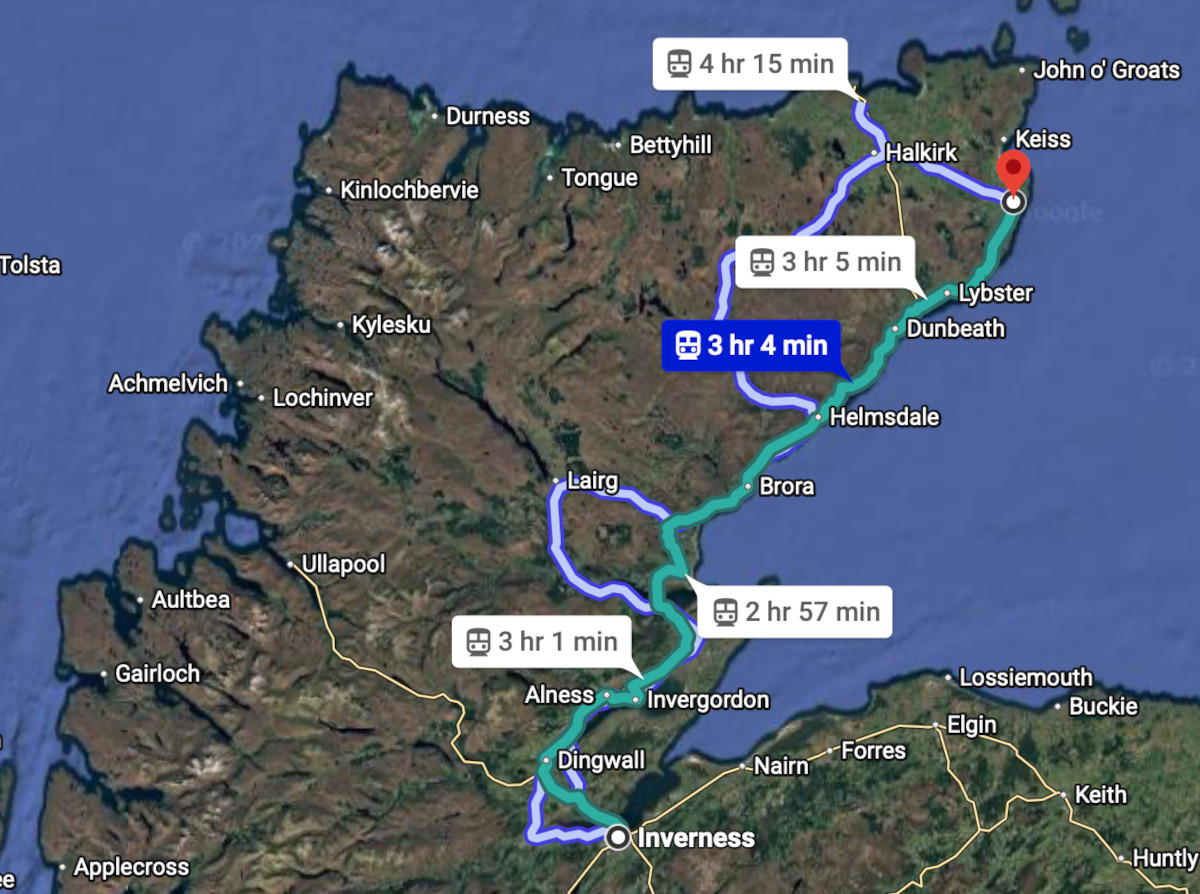
I started this thread far, far away - the far north of Scotland - and from there, whatever the fares, the railway takes a long and winding road across the vast peat bogs covering the moorlands of Caithness to avoid the great scars sliced into the coastal cliffs along the North Sea coast. After following the coast from Helmsdale through Brora and to Golspie, it then cuts inland again via Lairg to cross the Kyles of Sutherland upriver of the estuary at Invershin/Culrain, before making another great detour around the head of the Black Isle via Dingwall, to arrive into Inverness - although it's the "Far North Line" from the West.
There have - always - been roads with difficult gradients from Wick to Helmsdale, going down and up the magnificent valley slopes from the high moorland to nearly sea level, crossing the valley, and back up the other side. Modern railway engineering would, no doubt, allow for high viaducts to be built, and modern traction would allow far fiercer gradients, but it has not been done.
Across the Kyles of Sutherland at the Dornoch Firth, a long causeway now provides a road access to the south from Brora and north thereof, cutting the road distance from Golspie to the south by many miles and many, many minutes. No engineering reason it could not have included a railway line, but it didn't.
The again, across the two great sea slashes into the coast that form the "Black Isle" - really a peninsular, high quality / speed roads have been built which get you from Invergordon to Inverness in a fraction of the time - and with a fraction of the fuel burn - that the road around the end (and that's the way the railway still goes) would take. In days gone by, the Kessock Ferry would take you part of this road route. No need these days - it's bridged - but for road only.
Looking at Google for Journey planning this morning, I am offered around 3 hours by bus / coach and 4 hours and 15 minutes by train from Wick to Inverness. Even if the cost were equal, most people would elect for the bus? Of course, it's not that simple - the train and bus also both serve Thurso though in opposite directions, and there the timings are broadly equal at 3 hours and 45 minutes. And, I would suggest, cost becomes a far more headline consideration. And looking further south, intermediate places served by one but not the other mode help justify both, as does the comfort, tourist nature, and ability to connect south within the same station for the train.
A picture found online - shared "members only" here as it's not mine - was a stark reminded of road v rail, USA style
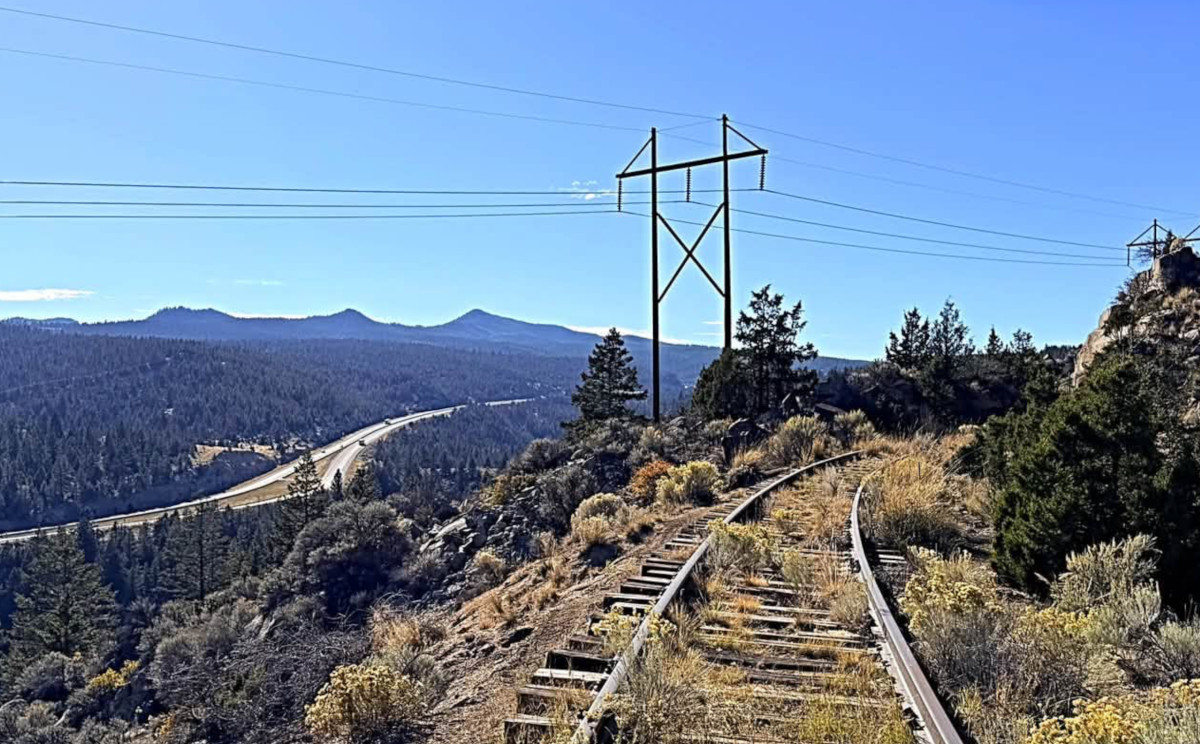
[MO]
